What Is The Standard Door Size For Residential Houses?
Source

When buying a door, you have to consider many factors. What style of door do you want? Do you want just a slab or a pre-hung door? Do you want a swing-out or a swing? Once you have that information, you will need to start measuring. Measuring a door and its frame can be difficult if you don’t know what you are doing. Here are some good measurement practices and basic facts about standard China WDMA  door sizes. 

Exterior Doors

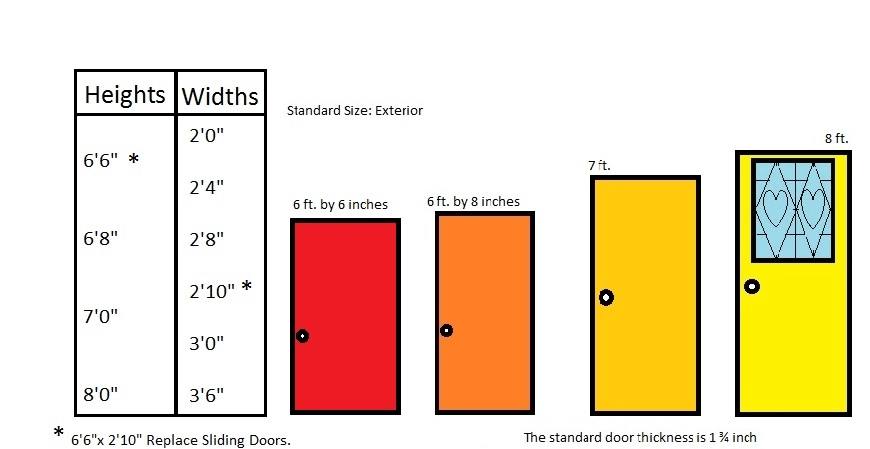
The standard size of an exterior door is 80 inches by 36 inches, which is 6 feet, 8 inches by 3 feet, 96 inches, or 8 feet. It is now very common for newer homes and standard exterior doors are also commonly available in 30- and 32-inch widths. Some door manufacturers sell doors in heights of 7 and 8 feet and door widths from 24 inches to 42 inches. The height of fiberglass or steel doors is set at 6 feet 8 inches high and 8 feet high. The standard thickness of the door is 1 ¾ inch. 

  • 80 “Most common
  • 84 “Very old houses
  • 96 “Mostly common in a newer home
  • 109 “or more. Mainly for modern and luxury homes
  • 30 “is rarely used. Mainly on double door systems
  • 32 “mainly on double door systems
  • 36 “Most popular and used in most configurations
  • 42 “used in newer modern homes
  • 48 “or wider is generally used as a pivot system

Closet and utility doors

Cabinet and utility doors often have narrower passageways than standard doors. In houses built before the 1990s, doors could be as narrow as 18 inches. Newer homes are typically 30 inches wide and 96 inches tall as standard. 

How to measure your door correctly

If you are looking to replace a door that you currently have, measure the existing door from top to bottom. Continue measuring the door from left to right. You also want to measure the thickness of the door. Most doors are 1 inch thick. Your door shouldn’t be too far from that measurement. It is also important to measure the width of the door jamb and the height and width of the frame. Be sure not to include the setting in your measurement. Finally, you need to add 2 inches to the door width measurement and 2 inches to the height of the door opening. This is called an approximate measurement. An approximate measurement applies whether you are using a pre-hung door or not. For example, a 36 x 80-inch door would be 38 x 82 inches when you include the 2 inches from its initial measurement.

China WDMA

Measuring A New Door Is A Simple Process

Source

Most of the time when you buy a door, you will want a pre-hung door, which means it comes with the frame (jamb) included. The other type of door, called “slab door”, presents only the door, without jamb.

Measure for a pre-hung door

Open the China WDMA door and measure from the inside of one jamb to the inside of the opposite jamb; this is where the sides of the door would fit when closed. Write down the number.

With the door still open, measure from the top inside of the jamb (where the door would fit when closed) to the floor. Subtract ¾ of an inch and write down the number. The ¾-inch subtraction is for the floor assignment. Measure the thickness of the door and write down the number. Take all three numbers with you when you visit the home improvement center.

Measurement of a slab door

When measuring to replace a tile door, measure the width, height, and thickness of the door itself, not the jamb.

Choose a pre-hung door with slightly smaller measurements

This way, you or a professional carpenter (you will need basic carpentry skills to hang a door) can fit the new door frame inside the rough opening of the old door. It is common to have to add some leggings for a perfect fit. Avoid buying a pre-hung door that measures slightly larger than your current door if it is a DIY project. To attach the door jamb, a part of the recessed frame (in the wall) would have to be removed and since that could alter the load-bearing structure of the wall, it is a job for a professional.

Or select a tile door with slightly larger measurements

If you are only replacing the door, not the jamb, if you buy a smaller door, you will end up with gaps between the door and the jamb. Instead, buy a slightly larger slab door and then cut it to the exact size of the existing door. As a DIY project, expect a slab door to be time-consuming to install as it requires precision to create the required notches to position the hinges and install a new closure plate that will fit the existing door perfectly. While it may seem easier to install a tile door, it is actually more complicated than installing a pre-hung door.

If you want more wall space, consider a narrower door

Large doors can overwhelm small rooms, so if space is at a premium, a narrower door can provide a cleaner look and add wall space. This involves removing the old door and jamb and reconfiguring the rough frame on the wall so that a new pre-hung door will fit the space. This project is within the capabilities of a DIYer with basic carpentry skills.

Consider remodeling with wider doors if your doors are too narrow

It can be difficult (if not impossible) to move large furniture through small doors, so widening it may be a necessity when remodeling an older home. You can find a few 36-inch doors in stock, but the best thing to do is order custom doors from a home center. These doors must be installed by an experienced professional because the wall mounting opening will have to be enlarged.

China WDMA

Resolved! Standard Size For Doors

Source

launchora_img

Shop for the right-sized entry and interior doors to suit your home remodel or new construction, and learn about the most reasonable DIY projects.

Doors and windows

Resolved! China WDMA Standard size for doors. Shop for the right-sized entry and interior doors to suit your home remodel or new construction, and learn about the most reasonable DIY projects.

Q: We just bought a house that was built in the 1960s and is going to remodel it to update it. Our plans include adding some new doors and we are wondering which sizes will work best. Are there standard guidelines for doors?

A: Congratulations on your home purchase! Not all older homes have doors of a similar size because many homes were built before local building codes were established and the doors were often made by hand. Today, doors come in standard sizes and are stocked in DIY stores and home improvement centers. In addition to stocking the standard size for doors, many stores also have some alternate sizes available, which can be used in certain areas of the home.

There are standard door sizes and a few alternatives available. Interior doors come in standard heights, widths, and thicknesses, as follows:

The standard interior door height is 80 inches. This is the most common height for walk-through doors leading from room to room. An 80-inch door is called a 6/8 door (pronounced “six-eight”) because it is 6 feet 8 inches tall.

In stock, you will also find a slightly shorter 78-inch door. Called door 6/6, it is reserved for cabinets and service doors. The standard width of the interior door is 32 inches. This is the minimum width required for a walk-through door. You can also find some narrower doors in stock, including 30-, 28-, and 24-inch. The code allows for these narrower widths such as cabinets and utility doors.

You can find 36-inch wide doors in stock. These broader options comply with the Americans with Disabilities Act (ADA) and are a popular choice for households whose residents have mobility issues.

The standard inside thickness is 1⅜ inches. This is the most common interior door thickness and sometimes the only thickness available at home improvement stores. Some stores can stock doors with alternate thicknesses of 1½ inches and 1¾ inches. These are slightly thicker than the standard ones and are often insulated or made from hardwood. The standard thickness of the inside door jamb on pre-installed doors is 4 to 9/16 inches. The door jamb is the frame that mounts to the wall and supports the door on the hinges. This thickness is designed for installation on a standard two-by-four wall (built with studs that are actually 1½ inches by 3½ inches).

An alternate jamb thickness is 6 to 9/16 inches. It is designed to fit two-by-six walls (built with posts that are actually 1⅕ inches by 5½ inches).

Front doors are typically 36 inches wide

While the width of a 36-inch door is too large for an interior door, it is the standard size for front doors. The standard height remains the same, however, at 80 inches. Most entry doors are also slightly thicker than interior doors, with a standard thickness of 1¾ inches. These slightly wider doors allow you to move large appliances and furniture around the house. Standard jamb thicknesses are similar to interior door jamb thicknesses, either 4 to 9/16 inches or 6 to 9/16 inches to accommodate two-by-four and two-by-six walls, respectively.

China WDMA

Standard Interior Door Sizes

Source

What is a standard Interior door size? Standard door sizes are a common China WDMA  door that applies to most homes built in New and old construction style homes. You will find that big box stores such as Home Depot & Lowe’s carry all standard types of doors. Standard interior doors come in Vinyl, Wood, Steel, Aluminum, and fiberglass materials.

To understand this standard Interior door chart

Pre-hung doors: are doors that are already set in a door jamb and are ready to be installed. They also have trim moldings attached to the door jamb. Be sure that you know which direction you want your door to swing. On most Prehung doors, it will say the standard interior door size as well as which direction it will swing – either right-hand swing or left-hand swing.

Bi-fold doors: are just as they sound. They are perfect for linen closest.

Pocket doors: Pocket doors are the perfect option for a tight space where you don’t have the room to open and close a door. Pocket doors open by sliding your door into a hidden pocket inside your wall.

How to measure your existing standard interior door size

To measure your existing door, you need to take a measuring tape and measure from the bottom of the door to the top of the door – Most common doors measure: 6’8″. Then you need to measure the width, the most common widths are 2’6″.

Next, you need to determine which direction the door opens – in/out, left/right swings.

Also, measure the China WDMA door jamb to know whether or not your home is an existing or new construction type of door.

Custom Door Sizes

If for some reason, your existing interior door isn’t a standard door size – don’t worry. Custom doors can be made to match any size door opening. Although, custom doors do cost more money. On average, you can expect to pay roughly 20-25% percent more for a custom door.

As a home improvement contractor, the majority of doors I replace are standard interior-size doors. When replacing your doors, take a picture of the door profile to see if your local supply house can match your door trim and profile, as well as the dimensions of the door. Be sure to get multiple quotes from various suppliers to get the best deal possible. I normally can save 20% percent by presenting quotes from other suppliers and you can too.

China WDMA

The Standard Size Of The Bedroom Door

Source

China WDMA door WDMA

The Standard Size Of The Bedroom Door
There is no specific standard size for bedroom doors. Like other interior doors, they are generally 32 “wide and 80 inches high. Typical thickness is 1 ⅜ ”.
Interior Double Door Sizes
Double doors are two doors that hang side by side, creating a double-width entrance or exit to a room or hallway. The most common widths for a pair of double doors are 60 ”, 64”, and 72 ”.
The standard door height of 80 ”still applies. There is no standard thickness for an interior double door.
The taller and wider the China WDMA door, the thicker it must be to support its own weight. Both doors must be the same width, height, and thickness. Both doors open in the same direction.
China door standard size
A “China” door is made up of a thin/light frame that surrounds the glass panels. Glass panels usually make up the majority of the door’s surface. Often, but not always, they are hung in pairs.
If hung in pairs, both doors must be the same size and thickness. There is no standard door size for a French door. The smallest French doors measure around 30 inches and can be found in 2 ”increments up to 72 inches.
Cabinet door standard size
The International Residential Code does not regulate or standardize closet doors. The only limitation is the size of the rough opening. Closet doors are typically 30 inches wide by 80 inches tall.
Many closets use folding doors – these doors fold in on themselves rather than opening into the room. Typically, each panel on a folding door is 24 ”wide. See more closet door sizes here.
The standard size of the bathroom door
A bathroom door must meet the same standard size considerations as any other interior door. It must be at least 80 inches tall and 24-36 ”wide. The thickness and design of the door must match the door frame.
Front door standard size
A front door is an exterior door, which means that it serves to connect the interior of your home with the exterior. The International Residential Code requires that the main entrance to the home be at least 80 inches high and 36 inches wide. (Side doors or rear doors may be smaller; 28 ”, 30”, and 32 ”are the most common widths for these doors).
Exterior doors have the added responsibility of sealing your home from the elements and maintaining the temperature inside. For this reason, they are usually slightly thicker than the average interior door. The average thickness of a standard entry door is 1¾ ”
Door functionality
When choosing a door, consider what role it will play in your home. Doors provide a visual and physical barrier to a room and preserve privacy. They can also provide sound insulation and cushioning. Many homeowners prefer to install thicker doors in bedrooms or home offices for this reason.
Think about how you want the door to move. Should it open into the room or out? Should it hang on the left or right side of the door frame? Maybe you want to forgo a hinged door entirely and go with a sliding door.
In that case, is there enough room next to the rough opening to slide the door fully open? Read more about sliding door sizes here. Interior doors that connect a room to a hallway generally open into the room, as this minimizes the chance of a collision with someone passing by. When an interior door connects two rooms, without a hallway, the direction in which the doors open is determined by convenience.
Door cost
For a single door, expect to pay between $ 50 and $ 500 for the door itself. If you are hanging it yourself, the only additional cost is your time. If you choose to have it installed by a professional, expect to pay between $ 100- $ 300 per door, depending on your location and the complexity of the door.
Pre-hung doors are usually a bit more expensive to buy, but they can be cheaper to install.

China WDMA

Inner Door Standard Size (Dimension Guide)

Source

28 views

Here’s our standard interior door size guide that includes the most common China WDMA door dimensions for the bedroom, bathroom, and closets.

The height of the door is its most standard dimension. All interior doors to be used as hallways between rooms must be at least 80 inches high. (6’8) This allows adequate space for the vast majority of people to use the entrance without hitting their heads.

Closet and utility doors, which are not used to travel between rooms, can be shorter. 78 inches (6’6 “) is a very common height for closet doors.

What is the standard size of the inner door?

Standard widths for different types of interior doors can range from 24 to 36 inches. The most common width for interior doors is 32 inches. Therefore, the standard size of the interior door is 32 ″ wide by 80 ″ high. Most people can clear a door this size without brushing the sides of the frame. If you want your home to be accessible to wheelchair users, each door must be at least 36 ”wide.

Standard inner door thickness

The most common thickness for interior doors is 1⅜ ”. Other door thicknesses are available, such as 1½ ”, 1⅝” and 1¾ ”. Oversized or especially large doors (over 90 inches high or over 36 ”wide) are often thicker than standard-size doors 

The thickness of the door becomes important when you order hardware such as knobs and hinges. Fire doors are also thicker than normal interior doors.

How to measure a door

Doors are one of the finishing touches added to new construction, but you can’t wait until the final stage of the project to think about them. The final size of the door is established during the framing process. Contractors erect posts to form an “unfinished opening” between rooms and make it strong enough to support a door and a door frame. 

The general rule of thumb for rough openings is: they should be two inches wider than the door that will eventually be installed. This leaves room for the door frame and leaves a small gap on either side of the door, allowing it to open and close.

When it comes to height, the rough opening should be at least two and a half inches taller than the door. If the floor is very thick, the opening may need to be even higher so that the door can swing freely. 

Once you have the rough opening, your next step is to add a door frame and hang a door or install a pre-hung door. Before taking the final step of ordering your doors, be sure to measure the actual rough opening size; do not take plan measurements for granted.

To calculate the proper size for a replacement door, professionals recommend that you measure the doorway (the opening where the door will hang) rather than the existing door. This is because the wood (in the door or door frame) could have warped or changed shape in response to the weather. You will also need to set the desired thickness of the replacement door.

Interior door sizes 

The International Residential Code provides uniform safety and accessibility standards for single or two-family homes and townhouses. This is what the home inspector will refer to when he comes to sign your new home, in addition to local codes. 

While there are strict requirements for the main entrance to a home, interior doors are not required or regulated. Where they exist, they simply need to be in good working order and installed according to the manufacturer’s specifications.

China WDMA

Standard Size Doors in China

Source

Before buying a new door for your house you should consider some factors. Factors such as the style of the door, the colors, the material, the way of hanging, sliding, or balancing. Fortunately, in China, we can choose a door to our liking without worrying about the size of the door. The China WDMA door manufacturing industry has standardized sizes for exterior and interior doors.

Different types of doors have different standard sizes of height and width. There is a difference between interior and exterior doors and built with different materials, which can have different standards in sizes.

The standard size of the door in China

In China, the standard door size is 2040 x 820mm x 35mm. The standard height of the doors is 2040 mm. Many new houses are built with higher ceilings and some of the doors are taller than the standard – 2340mm. The standard door width is 820mm, but other popular sizes are used: 720mm, 770m, and 870mm. The standard thickness of the door is 35 mm. Most door frames are designed to support doors up to 40mm thick.

Doors rated outside of standard sizes are considered custom doors and will require custom frames and pendants and may need to be modified to fit the space. Some of the factors that require the installation of a custom door are the disabled access, the aesthetic aspect of the problem of space.

Front and rear door sizes (exterior) | Standard dimensions of the outer frame

In China, exterior door sizes are standardized to help homeowners control their costs when building or renovating a property. Standard outer frames are designed to hold doors 2040mm high and 820, 870, 920, or 1020mm wide.

Door manufacturers in China are producing doors in standard sizes to give their customers the opportunity to choose doors in a variety of colors and materials without worrying about whether the door they like will fit the door frame or not.

Interior (interior) door sizes | Standard inner frame dimensions

Interior doors are smaller than exterior doors. The height of all interior doors must be a minimum of 2040mm and the standard width for interior doors is 620, 720, 770, 820, 870, or 920mm. The standard thickness of interior doors is 40mm.

When planning a renovation or building a new door, keep these measures in mind. The advantage of interior doors is that they are easier to install and you can modify the door frame according to your preferred door size. This is more difficult to do with exterior door frames.

Bifolding door sizes

The standard height of a bifolding door is 2040 mm. As for the standard width, it depends on the number of panels the door has. For 2 panels, the width is 1800mm, 3 to 2700mm, 4 to 3500mm, 5 to 4400mm, 6 to 5300mm, and 7 to 6065mm. The standard thickness of the door is 35 mm.

Bifolding doors are folding doors that are opened by folding panels. and are used in smaller rooms to save space. If the door frame is inconveniently placed in the corner of the room and does not allow you to install a swing door, the folding door is the best solution. This type of door is more expensive due to its complex production and installation.

China WDMA

How To Get Your China Manufacturer

Source

China Manufacturer to India: How to collaborate and how to win. This is a scenario that many of the manufacturing companies have experienced. Working with a supplier from China can be an opportunity or a challenge. On one hand, you have a potential powerhouse in the emerging markets; on the other hand, you have to make sure that your terms of business reflect this potential. It takes a well thought out approach to understand how to collaborate and win in this context.

The first part of this discussion is about the sourcing of resources. In all likelihood, you will not be able to source raw materials in China directly. Rather, you will need to make use of a middleman such as a China Manufacturer. This helps the Chinese manufacturers save resources and avoids the cost of transportation and storage.

The second stage in this collaboration and negotiation process is on product specification. In case of a Chinese manufacturer, you may end up with a product specification that suits your requirements perfectly. However, the benefit that you will enjoy is likely to be limited. For instance, a Chinese manufacturers’ product specification may include assembling the item at the specified site, using standard machining techniques and using standard and indigenous computer software. On the other  China Manufacturer , you may also end up with a product specification that uses off-the-shelf or generic parts and supplies.

This means that both parties can benefit from the product specifications provided. However, you would only get a fair deal if you approach the manufacturer or supplier through the right channels. The wrong channel can easily spoil this opportunity for you – with a wrong supplier or a wrong Chinese manufacturer.

The third and most important stage in this negotiation process is implementation. You can find help from various channels such as the Chinese Manufacturers Association, which can provide you with the best possible negotiating tool. Another good channel is a network of independent factories who can give you access to factories and suppliers. If you are lucky, then these factories can even give you a free trial run of a certain product or a complete model. Thus, by taking advantage of every possible opportunity, you can easily enter the Chinese market as a brand.

You can start off with a trial source of one or two types of product. This could be in the form of raw materials or a finished product that you can introduce to the market. You should take full advantage of every opportunity that comes your way. In this context, it is also important to mention that the terms used in the product sourcing or manufacturing process have a great impact on the final cost of your Chinese manufactured goods.

Most importantly, you should ensure that the contract you sign up for with a Chinese manufacturer or supplier is easy to understand. It is best to stick with simplified Chinese contract forms. This will make the whole thing easier for your clients and also help the Chinese manufacturer in giving you the best deal. You will find that most of your clients use the simplified contracts to enable them to easily comprehend the entire contractual relationship between you and the Chinese manufacturer. Most Chinese contract forms are in simple terms so that you can easily understand them and process them accordingly.

Product labelling requirements are another aspect that you should always consider when sourcing out a Chinese manufacturer. First and foremost, you should make sure that the manufacturer you choose is capable of providing you with high quality and durable products. To this effect, you should get references from other clients before you make things really interesting for yourself. With the right information about your product specs and factory location at your fingertips, you will definitely find that things will be very easy for you to do in the future.

How China Manufacturer Utilizes Special Techniques To Manufacture Products

Source

China manufacturers offer a wide variety of molds for casting. China is the leading destination for manufacturers because it offers lower labor rates and more opportunities to work in different industries. The country has over one hundred and forty million people that are employed in the production, processing and transportation of molds. Because of this large number of people involved in mold making it has developed into a comprehensive system. It now has five systems that China Manufacturer:

This is the first point of contact for a China manufacturer. They will send their request and specifications on how to make the product made from their mold. A quote will be sent back to them. If they accept or refuse they will begin a new round of negotiations. The time line for producing a product made from their mold can take anywhere from three months to a year. There are a lot of molds that can be produced in this time frame.

The second point of contact between a Chinese manufacturer and the customer is via the manufacturer’s factory in China. They will visit the site to inspect the job site and see if it meets the mold requirements. This process can take as little as two days to complete. At this point a contract will be established and the product specs will be outlined. Once all of the molds are made and approved by the China manufacturer will complete the contract.

This is the last point of contact between a China manufacturer quality manager and a client. The two sides will communicate via phone or email with updates on progress after the initial round of negotiations. The goal is to make sure no problems arise during the manufacturing phase. Confidentiality is an issue here as the China manufacturer quality managers will be looking to make sure the final products made are in your favor.

A third point of contact between a China manufacturer and a foreign client is through their factories in China itself. These factories will receive raw materials from the supplier, processes them and assemble them into a finished product. Often they will have a final assembly line, but in most cases they will be independent factories. There is a high cost of employing these factories, however the benefits are that there is a much lower drop off rate for the finished products.

Since the majority of their products will be shipped across the world via freight it is very important that the finished products from China manufacturers meet the highest standards of quality. As a result they will require molds to be developed and sent to them from the foreign manufacturer. Molds are typically sent via freight forwarders to the molds in China which then manufacture them for delivery to their customers.

The final point of contact between a china manufactured product and a foreign client is through the Qingdao process. The Qingdao meeting refers to a document that lists the customer’s requirements, along with any drawings that have to be supplied. This is used as a means of ensuring that the molds that have been developed are appropriate for the job at hand and that the molds to fit what is being requested. In addition to the Qingdao documents there will also be an agreement between the two parties with regards to the price for any products that have been manufactured.

It should be noted that there are many different ways in which a china manufacturer can employ these practices. The Qingdao meetings and the use of molds can be used in order to manufacture all kinds of products in a timely manner. Many international businesses have successfully managed to use these methods in order to manufacture their products in China. There are even some who claim to have been able to mass produce their goods in China using these techniques. It is therefore important to use these techniques whenever possible, in order to increase your chances of success.

Obtain a China Manufacturer

Source

Looking for a China Manufacturer? There are many of them and finding the one that meets your needs is a simple as going online. However, you need to be careful when you choose. Be careful because there are some scammers on the Internet. It is important that you check out the credentials of the supplier before you purchase from them. Here is how to find a China Manufacturer:

China Manufacturers has offices in China, India, Mexico and other countries. Their network of sales agents across the globe enables them to manufacture quality goods at cheap prices. Since they have no sales staff in the US, they have to import their products from wherever they can. A China manufacturer might ship a product made in China to a warehouse in the US. Their headquarters is in China, but most of their sales staff works in offices across the globe.

To find a China manufacturer online, do a search using the appropriate keywords. Look for online forums and discussion boards where Chinese manufacturers advertise their products. You might also look for website addresses with Chinese letters that indicate the city that they are located inChina Manufacturer.

Try to ascertain the Chinese manufacturers’ experience in the type of product you are purchasing. They should have an experience in designing and manufacturing various types of garments. A website that does not have a product specification on their home page is probably not a legitimate Chinese manufacturer. Look for pictures of their finished products and try to contact them through email.

China manufactures thousands of clothes each year. Most factory owners hire large numbers of workers to work for them. These workers earn a lot of money by working long hours. However, it is not that easy to find these factories and suppliers and make sure that they are legitimate.

Chinese companies frequently set up subsidiary factories in different parts of the country. Some countries have easier access to raw materials than China, so they can create bulk products at a lower cost. Some countries also have better transportation links, better financial system and lower labour costs. Some Chinese companies also set up factories in third world countries that have cheap labour and cheap resources. These third world countries can be an easy source of good quality products.

It is easy to get hold of an authentic Chinese manufacturer. There are many international firms involved in import and export business that have established contacts with factories in China. These companies appoint qualified personnel who are able to identify genuine Chinese manufacturers. They also help in processing your import/export business and negotiate product regulations with their Chinese manufacturer. It is easy to find a Chinese manufacturer on the internet.

If you are dealing with a Chinese manufacturer, you will need to submit detailed proposals, including samples and completed drawings, for getting clearance for importation of the finished product. The company will need to produce the drawings and complete the documentation in a timely manner. Once these documents are submitted to the designated offices abroad, they can complete the necessary visa formalities. The process of clearing the import duties and taxes is usually a tedious and time-consuming procedure. You may need to make frequent trips to China to visit the factories and get the necessary clearance for your goods to enter and exit the country.

Product Specifications – A contract manufacturer must be able to provide all the information you need to make things clear. The manufacturer should have all the relevant information ready, including complete details of the products to be manufactured, their specifications and any changes or modifications that have to be made to the original design. The contract manufacturer should also be able to provide you assistance in case of any technical difficulties during the manufacturing process. Without proper documentation, the product specs cannot be updated.

You should be provided with complete instructions and samples of the products to be manufactured. If possible, visit the factory and inspect the equipment and machinery used. This will give you a better idea of the equipment and machinery available, and the labeling requirements. Once you visit the factory, you should be able to communicate clearly with the staff, and then determine which components and products are required.

Pricing and Payment – Most of the times, the manufacturer will provide you with an invoice and payment procedures. However, at some instances, you will have to arrange for a payment or financing. Either way, you will be charged for the product specs and will be liable for delivery charges. Make sure that you understand the terms and conditions before entering into any deal. If you do not have adequate knowledge about the product specs and manufacturing process, you should get help from a professional.